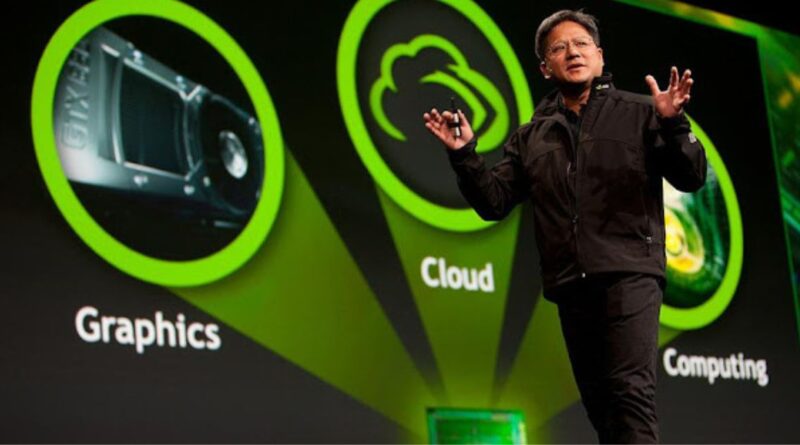
Does AI Create Jobs? NVIDIA CEO Jensen Huang Fires Back at Global Fears
The Head of NVIDIA Challenges Narratives on Mass Unemployment, Asserting AI as a Massive Engine for New Opportunities
The intersection of Artificial Intelligence and the labor market has become one of the most polarizing topics in the global tech landscape. As 2026 progresses, the anxiety surrounding “AI job replacement” has reached a fever pitch, with labor unions and white-collar workers alike questioning their future stability. However, Jensen Huang, the visionary CEO of NVIDIA, is championing a counter-narrative that is as bold as it is optimistic.
While many focus on the risk of mass displacement, Huang asserts that AI is actually “creating an enormous number of jobs.” This perspective isn’t just corporate rhetoric; it comes at a time when NVIDIA has solidified its position as the backbone of the AI revolution, with its Blackwell chips powering the world’s most advanced data centers. According to Huang, we are not witnessing the end of work, but rather the beginning of a profound human expansion enabled by silicon.
NVIDIA’s CEO Breaks the Common Narrative
During recent high-profile industry summits and interviews—including a notable appearance on the TechCrunch stage earlier this week—Jensen Huang adopted a blunt and direct tone when addressing the impact of AI on the workforce. He argues that the historical precedent of technological advancement always points toward job creation, even when the initial transition feels disruptive.
Huang stated that instead of destroying the labor market, AI is driving a new wave of role creation. He describes AI as a “productivity multiplier” that allows companies to take on projects that were previously impossible due to scale or complexity. In his view, the technology is amplifying human potential rather than replacing the human element entirely. This stance serves as a direct challenge to the growing fear of “Total Automation,” suggesting that the human-in-the-loop will become even more vital as systems become more capable.
Why AI Can Generate More Jobs
The logic presented by the NVIDIA CEO is rooted in the “transformation of tasks” rather than the “elimination of professions.” History shows that when the cost of a certain task decreases (through automation), the demand for the output of that task often increases, leading to more hiring in related sectors.
As AI advances, we are seeing an explosion in demand for new, specialized roles that didn’t exist five years ago:
AI Data Architects: Professionals who design the pipelines for massive datasets.
Prompt Engineers & Evaluators: Experts who refine and “tutor” AI models to ensure accuracy and safety.
Autonomous System Supervisors: Humans tasked with overseeing complex automated workflows in logistics and manufacturing.
AI-Enhanced Creative Leads: Artists and writers who use generative tools to produce high-volume, high-fidelity media.
In short, the market is not shrinking; it is undergoing a structural adaptation.
Industries Experiencing the Most Growth
Technology & Infrastructure: Massive hiring for data center management and chip design.
Digital Marketing: Utilization of AI for hyper-personalized consumer experiences at scale.
Healthcare & Biotech: AI is creating thousands of roles in drug discovery and personalized medicine.
Creative Industries: New hybrid roles blending traditional design with algorithmic tools.
Digital Education: A surge in demand for educators who can teach AI literacy and ethics.
The Fear Among Workers is Real and Valid
Despite the optimism radiating from NVIDIA’s headquarters, the “boots on the ground” reality for many workers remains fraught with uncertainty. This concern is not unfounded. In operational, repetitive, and entry-level administrative sectors, automation is already beginning to replace specific functions.
The central tension lies in the fact that this transition is not happening equitably. While a software engineer might see their productivity double, a data entry clerk might find their entire department redundant within months. Current headlines, such as the public friction between Huang and Anthropic’s CEO Dario Amodei regarding the “God complex” of AI developers, highlight the ethical struggle at the top of the food chain: how much control should these systems have over human livelihoods?
AI as a Tool, Not a Replacement
Jensen Huang’s vision reinforces a critical concept: AI functions best as an “Augmentation Tool.” This creates a paradigm shift where the competition is no longer “Human vs. Machine,” but rather “Human using AI vs. Human not using AI.”
Professionals who master these tools tend to produce higher quality work with greater efficiency, making them indispensable to their organizations. This is creating a new, sharp divide in the global economy:
The Empowered: Those who integrate AI to elevate their output.
The Displaced: Those whose roles are tied to tasks that AI can now perform faster and cheaper.
The Global Impact Has Already Begun
Companies worldwide are pouring billions into AI infrastructure, creating a massive “domino effect” in the global economy. NVIDIA itself is the primary beneficiary of this trend, as its GPUs are the essential fuel for training Large Language Models (LLMs).
This shift is no longer a “future prediction”—it is a structural change occurring in real-time. In a recent report from The Times of India, the friction between tech leaders regarding the speed of AI deployment shows that the industry is at a crossroads. The debate isn’t about whether AI will change the world, but about who will set the rules for the new economy it creates.
The most likely scenario for the next decade is not a collapse of the labor market, but an accelerated evolution. Traditional professions will not disappear; they will evolve. A lawyer will become an “AI-assisted legal strategist,” and a doctor will become an “AI-augmented diagnostician.”
Digital skills and “AI Literacy” are becoming the new baseline for employability. The ultimate question facing the global workforce today is not whether AI will take their jobs, but whether they are prepared to be the ones who command the AI.
The perspective shared by NVIDIA’s CEO shifts the narrative from one of fear to one of adaptation. By viewing AI as an engine for growth and innovation rather than a mere threat, workers and businesses can better position themselves for the “Silicon Age.” While the transition will undoubtedly be challenging for many, the potential for a more productive and creative human future has never been higher—provided we learn to collaborate with our digital counterparts.
Are you actively preparing to integrate AI into your workflow, or do you still view its rapid advancement as a threat to your professional future?